
You’ve just sharpened your knife – and yet it’s not cutting as it should? The reason is almost always the same: the last and most important step was skipped. Stropping on a leather strop is not an optional luxury, but the decisive final step in every sharpening process. Those who know this step and apply it regularly dramatically extend their knife's edge retention – and save themselves unnecessary re-sharpening.
What really happens during sharpening?
Every sharpening process – whether on a whetstone, grinding stone, or sharpening device – creates a so-called burr. This is a very thin strip of metal that forms on the cutting edge because the metal is pushed aside under pressure instead of being cleanly removed.
Microscopically, after sharpening, the cutting edge is not a smooth line, but an irregular, jagged edge with loose metal residues. The knife feels sharp – but it’s not yet fully sharp. The burr breaks off uncontrollably with the first use, and the sharpness quickly diminishes. If you want to improve knife sharpness, you must remove the burr in a controlled manner – with a leather strop.
What is a leather strop and how does it work?
A leather strop – also known simply as a strop – is a flat piece of tanned leather on a wooden backing. Unlike a honing steel, it doesn’t remove material. It removes the burr, smooths the microstructure of the cutting edge, and polishes the blade surface to a razor-sharp level.
The result: a cutting edge that cuts more cleanly, stays sharp longer, and requires less effort – whether for cooking, hunting, filleting, or barbecuing.
How to properly strop your knife
The most common mistake when stropping: The knife is pulled over the leather edge-first. This cuts into the leather, damages the strop, and has no positive effect on the cutting edge.
❌ How to do it wrong

Incorrect: The edge points in the direction of movement – this damages the leather and achieves nothing.
✅ How to do it right

Correct: Spine first, edge pointing away from the leather, shallow angle of approx. 15–20°.
Step-by-step guide
- Secure the leather strop – Lay it flat on the table, one hand holding the handle firmly.
- Set the angle – Place the knife at the sharpening angle, approx. 15–20° to the leather surface.
- Pull spine first – The knife is pulled over the leather with its spine leading the direction of movement. The edge points against the direction of movement.
- Switch sides – After each pass, turn the knife over and strop the other side.
- Repeat – 8–15 passes per side for daily maintenance, 20–30 passes after sharpening.
Does the leather strop extend edge retention?
Yes – and this can be explained scientifically. During use, the razor-thin cutting edge microscopically bends to the side. It doesn't break off – it folds over. A brief stropping straightens it again without removing material. The knife is then sharp again, as if freshly sharpened.
Those who strop their knife briefly after each use will sharpen it significantly less often. Less sharpening means less material loss – and a longer blade life. With regular stropping, one sharpening process per month or less often is often sufficient.
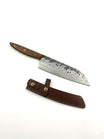
Hand-forged carbon steel knives like the Fyreza C100 steel knives particularly benefit. The steel's high hardness allows for exceptional sharpness – and responds excellently to stropping. Anyone who owns a Fyreza Nakiri knife, a Fyreza Chef's knife, or a Fyreza Bread knife should consider the leather strop a fixed part of their daily knife care.
Common stropping mistakes
- Pulling edge first – The most common mistake. Always spine first.
- Too much pressure – The knife's own weight is completely sufficient. Pressure bows the leather and changes the angle.
- Wrong angle – Always follow the knife's sharpening angle (approx. 15–20°). Too steep or too shallow polishes the wrong zone.
- Stropping too infrequently – Ideally, strop briefly after each use, not just when the knife is noticeably dull.
Conclusion: Small habit, big impact
A leather strop costs little, takes up hardly any space, and significantly extends the edge retention of your knives. If you want to maintain knife sharpness, increase edge retention, and protect your knife, there's no getting around a leather strop – especially for high-quality, hand-forged carbon steel blades.
Discover our hand-forged knives: