

In short: In Germany, you are permitted to carry fixed-blade knives with a blade length of up to 12 cm. One-hand knives and fixed-blade knives over 12 cm are not allowed to be carried publicly according to § 42a WaffG – transport in a sealed container is permitted. In Austria, there is no general blade length limit; only weapons are prohibited, not kitchen and utility knives.
→ For information on our hand-forged kitchen and outdoor knives – and how to transport them legally, see the conclusion below.
Introduction
Anyone who owns a high-quality knife will sooner or later ask themselves: Am I actually allowed to carry it with me? The legal situation in Germany and Austria differs in some respects – this article gives you a clear overview so that you are on the safe side.
Important note: This article is for general information only and does not constitute legal advice. As of: September 2026. In case of doubt, consult a lawyer or the competent authority.
Which knives are allowed to be carried in Germany?
German weapons law distinguishes between possession and carrying. You are allowed to possess almost any knife – at home, in the kitchen, in the workshop. "Carrying" means having a knife readily accessible outside your own home or property. This is precisely what the rules in § 42a WaffG apply to.
The following are not permitted to be carried:
- One-hand knives – folding knives whose blade can be opened and locked with one hand (thumb stud, flipper, hole in the blade). Blade length does not play a role here.
- Fixed-blade knives with a blade longer than 12 cm – i.e., almost all kitchen knives, hunting knives, and outdoor knives.
- Imitation weapons as well as certain bladed and thrusting weapons.
The following are permitted to be carried:
- Fixed-blade knives up to 12 cm in blade length – without special reason and also readily accessible.
- Folding knives that can only be opened with two hands or do not have a lockable blade – regardless of blade length. The classic pocket knife falls into this category.
For prohibited cases, there are two exceptions (§ 42a Abs. 2 and 3 WaffG): Transport in a sealed container is always permitted. And anyone with a legitimate interest – profession, hunting, sport, custom or a "generally recognised purpose" such as fishing or camping – may also carry the knife.
What blade length is allowed?
The 12 cm limit is the only length specification in German weapons law, and it only applies to fixed-blade knives. For folding knives, there is no length limit – the decisive factor there is solely whether the blade can be opened and locked with one hand.
In practice, the blade is measured from the tip to the hilt. You may carry a fixed-blade knife with an 11.9 cm blade, but not one with a 12.1 cm blade – unless you have a legitimate interest or transport it in a sealed container.
Important: This limit says nothing about possession. A 25 cm kitchen knife is perfectly legal in the kitchen. It just shouldn't be carried readily accessible through the city.
Carrying fixed-blade knives: What exactly applies?
Fixed-blade knives – i.e., knives without a folding mechanism – are the most common question, because almost every kitchen and outdoor knife falls into this category. The rule is simple:
- Up to 12 cm blade: Carrying permitted, even without reason.
- Over 12 cm blade: Carrying only with legitimate interest – for example, on the way to fishing, camping, hunting, at work – or as transport in a sealed container.
"Sealed" means: you cannot access the knife with just a few movements. A knife pouch with a zipper in a backpack, a case, a box in the trunk fulfills this. A sheath on the belt does not.
New since late 2024: Knife ban at events and on long-distance public transport
With the security package from October 2024, two new rules have been added that also affect short knives:
- Public events (§ 42 Abs. 4a WaffG): At folk festivals, sports events, trade fairs, markets, in cinemas, theaters and discotheques, no knife is permitted to be carried – regardless of blade length.
- Long-distance public transport (§ 42b WaffG): In trains and buses of public long-distance passenger transport, as well as in their stations and stops, carrying knives is prohibited.
Exemptions include: transport in a non-accessible manner (i.e., packaged), tradespeople carrying out their profession, catering establishments and their guests, hunting, sport and custom, and commercial exhibition at trade fairs and markets.
In addition, the federal states may establish weapon-free zones (§ 42 Abs. 5 WaffG), for example at train stations, public squares or on local public transport. In these zones, the knife ban also applies without a length limit. Which zones exist is determined by each federal state.
Which knives are completely prohibited in Germany?
Some types of knives are not even permitted to be possessed (§ 2 Abs. 3 WaffG with Anlage 2):
- Switchblades where the blade springs out forwards. Blades that spring out sideways up to 8.5 cm are only permitted with a legitimate interest.
- Gravity knives, where the blade falls out of the handle by gravity.
- Push daggers with the blade perpendicular to the fist.
- Butterfly knives (Balisong).
This is different from the carrying ban in § 42a: You may possess a 20 cm kitchen knife, but not carry it. You may not possess a butterfly knife at all.
What penalties are threatened?
Accuracy is important here, as the consequences differ greatly:
- Prohibited carrying – i.e., carrying a one-hand knife or a fixed-blade knife over 12 cm readily accessible without reason, or a knife at an event or on long-distance public transport – is a regulatory offense according to § 53 WaffG. It can be punished with a fine of up to 10,000 euros, and the knife is usually confiscated.
- Possession of a prohibited knife – switchblade, gravity knife, push dagger, butterfly knife – is a criminal offense according to § 52 WaffG with imprisonment of up to three years or a fine.
Knives in Austria: What is permitted?
Austria regulates the matter much more leniently than Germany. The Weapons Act 1996 has no blade length limit and no general carrying ban for knives.
According to § 1 WaffG, an object is considered a weapon only if it is "by its nature" intended to attack or defend people. Kitchen knives, hunting knives, outdoor knives, and pocket knives are utility items and not weapons – you are allowed to possess and carry them.
Prohibited under § 17 WaffG are, among other things, weapons that simulate another object or are disguised as everyday objects, as well as knuckle dusters, blackjacks, and steel rods. Switchblades and butterfly knives are not on this list – unlike in Germany, they are not prohibited in Austria.
However, there are two limitations:
- Weapon-free zones (§ 36b Sicherheitspolizeigesetz): In certain places, such as Vienna's Praterstern, no knife may be carried – regardless of type or length. Violations are administrative offenses.
- House rules: Event organizers, transport companies, and establishments can prohibit knives through their house rules.
The major Weapons Act amendment in 2025 almost exclusively concerns firearms. A nationwide knife carrying ban was discussed but not enacted.
Conclusion – Our Recommendation
Our hand-forged Fyreza knives are high-quality kitchen and outdoor knives – not weapons. Nevertheless, the following applies:
- ✅ At home and in the kitchen: permitted without restriction
- ✅ Transport for camping, fishing, hunting, or to the outdoor kitchen: permitted – packaged or with legitimate interest
- ❌ Readily accessible in the city, at events, or on long-distance public transport: prohibited in Germany, in Austria in prohibited zones
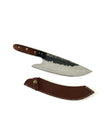
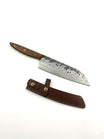
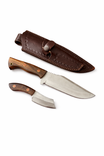
All hand-forged Fyreza knives have blades over 12 cm. They are kitchen and outdoor knives and should be carried in a sheath or knife pouch, not readily accessible in a jacket pocket. The hunting cutlery set with leather sheath is designed for this: knives securely enclosed, as required by § 42a WaffG for transport.
Always keep your knife securely packaged during transport – ideally in the supplied sheath in your backpack or suitcase. This way you are on the safe side.
And so that your knife remains sharp and rust-free even after years: In our care instructions for hand-forged carbon steel knives, we show you how to properly care for the blade and handle.