
In short: A good bread knife has a serrated edge, a blade of at least 22 cm and stainless steel that holds its edge for a long time. The serrations bite into the crust without you having to press down, so the crumb stays intact. It rarely needs sharpening, and when it does, it is done serration by serration or by a sharpening service.
Why a bread knife needs a serrated edge
A hard crust over a soft crumb is the most difficult thing in the kitchen for a straight blade. The straight edge slides off the crust, you press harder, and you squash the bread. The teeth of a serrated edge grip at single points, bite into the crust and saw through with a light pull. The pressure comes from the movement, not from your wrist.
The same effect helps with anything that is firm outside and soft inside: tomatoes, pineapple, crackling roast, cakes with a firm glaze.
Which blade length is right?
The blade should be longer than your loaf is wide. A country loaf is often 20 cm or more. With a short blade you saw back and forth several times, the slice becomes uneven and it crumbles. From about 22 cm, a slice goes through in a single stroke.
| Blade length | Suitable for |
|---|---|
| up to 18 cm | bread rolls, baguette, small tin loaves |
| 20 to 22 cm | tin loaves, medium loaves |
| 23 cm and more | large sourdough and country loaves, crackling roast |
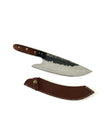
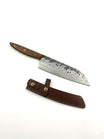
Our Fyreza bread knife has a 23 cm serrated blade, an overall length of 36 cm and weighs around 300 g.
Stainless or carbon steel?
For chef's knives, carbon steel is our first choice because it can be sharpened finely and quickly. With a bread knife something else matters: a serrated edge is rarely resharpened, so it has to hold its edge for a long time, and sourdough bread is moist and acidic. A high-quality stainless steel is the better solution for that.
We use Böhler N690, a stainless chromium steel from Austria with 58 HRC. It is hard enough to keep the teeth sharp for years and forgives you if the knife is not dried straight after breakfast.
What matters in the handle
You use a bread knife with long strokes. The handle therefore has to sit securely in your hand and balance the long blade. It is important that your knuckles do not touch the board while cutting. Our handle is ergonomically shaped from solid walnut; every grain is different.
Wooden handles do not belong in the dishwasher: wash by hand, dry and oil lightly now and then.
Can a serrated edge be sharpened?
Yes, but differently from a straight blade. A serrated edge is usually ground on one side only. It is sharpened with a tapered sharpening rod that fits into the individual serrations: serration by serration, only on the ground side, with a few light strokes. The flat back is then only stropped to remove the burr.
This takes patience. When the serrated edge wears after years of use, we resharpen it by hand in our sharpening service.
Frequently asked questions about bread knives
Why does my knife squash the bread?
Usually the blade is dull or too short, so you work with pressure instead of pulling. A sharp serrated edge needs almost no pressure.
How long should a bread knife be?
At least as long as your loaf is wide. For large loaves, 22 to 26 cm makes sense.
Which board is best for cutting?
Wood or plastic. Glass, stone and ceramic dull any edge in a short time, including a serrated one.
What else is a bread knife good for?
Anything with a firm skin and a soft inside: tomatoes, pineapple, melons, crackling roast and cake bases.
You will find more handmade blades from our forge in the knife collection. How to care for blades and wooden handles is explained in our care guides.
and balance the long blade. It is important that your knuckles do not touch the board while cutting. Our handle is ergonomically shaped from solid walnut; every grain is different.Wooden handles do not belong in the dishwasher: wash by hand, dry and oil lightly now and then.
Can a serrated edge be sharpened?
Yes, but differently from a straight blade. A serrated edge is usually ground on one side only. It is sharpened with a tapered sharpening rod that fits into the individual serrations: serration by serration, only on the ground side, with a few light strokes. The flat back is then only stropped to remove the burr.
This takes patience. When the serrated edge wears after years of use, we resharpen it by hand in our sharpening service.
Frequently asked questions about bread knives
Why does my knife squash the bread?
Usually the blade is dull or too short, so you work with pressure instead of pulling. A sharp serrated edge needs almost no pressure.
How long should a bread knife be?
At least as long as your loaf is wide. For large loaves, 22 to 26 cm makes sense.
Which board is best for cutting?
Wood or plastic. Glass, stone and ceramic dull any edge in a short time, including a serrated one.
What else is a bread knife good for?
Anything with a firm skin and a soft inside: tomatoes, pineapple, melons, crackling roast and cake bases.
You will find more handmade blades from our forge in the knife collection. How to care for blades and wooden handles is explained in our care guides.