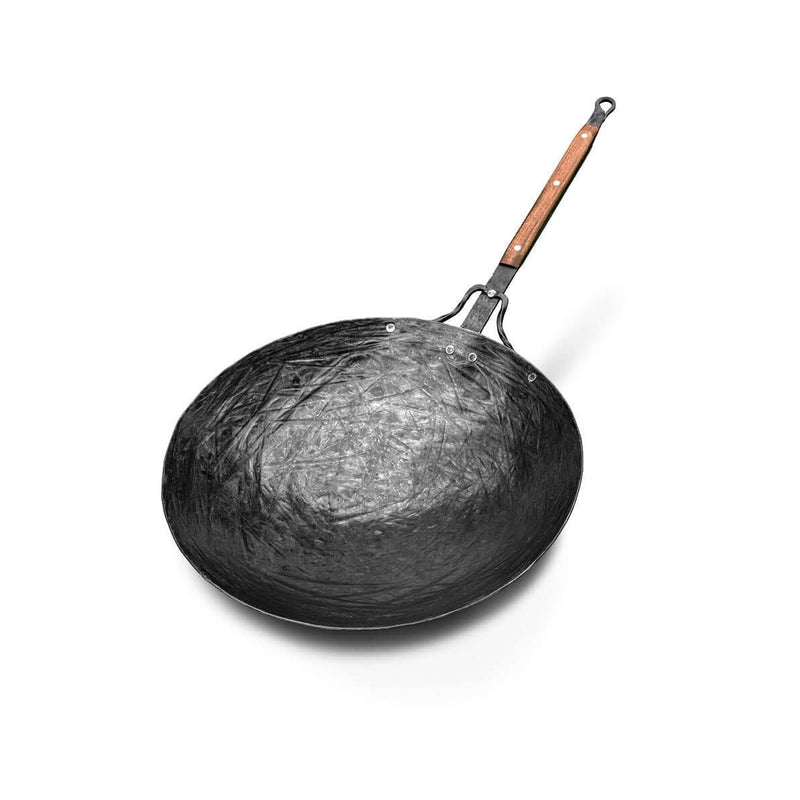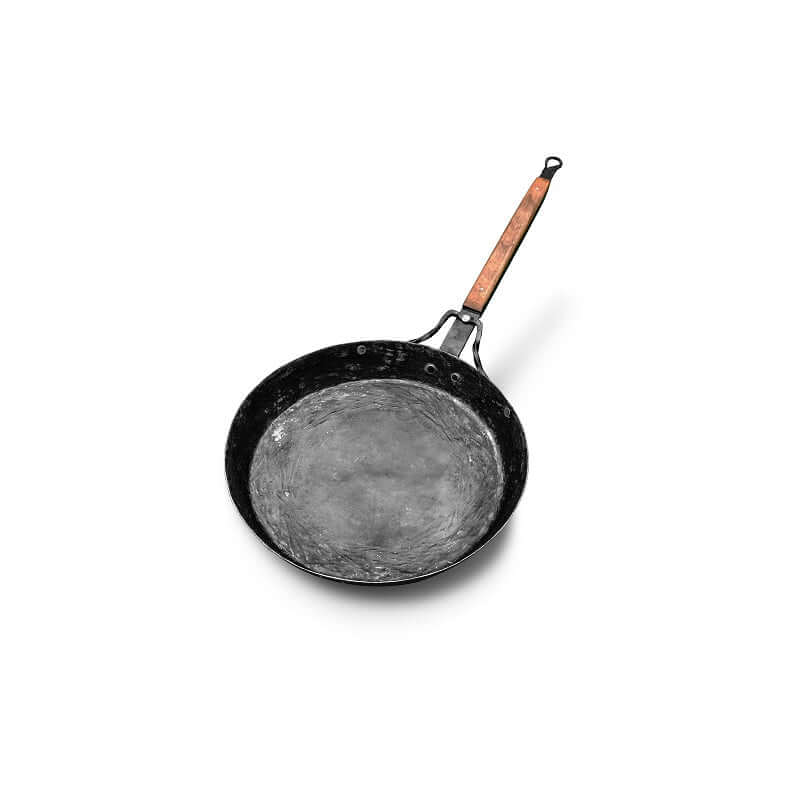
Care Instructions for Hand-Forged Fyreza Carbon Steel Pans

How to care for your carbon steel pans
A hand-forged carbon steel pan gets better with every cooking session. It doesn't have a coating that can flake off, but rather a patina: a thin, baked-on layer of oil that protects against rust and prevents sticking.
This guide shows you in six steps how to build and maintain it – from the initial seasoning to storage. With proper care, such a pan will last a lifetime.

Before first use: season
Your new pan comes raw from the forge and first needs a protective layer. Wash it with warm water and a soft sponge, without detergent, and dry it immediately.
Then heat it over medium heat and rub it with a paper towel and a very thin layer of heat-resistant oil – linseed oil or canola oil are good choices. Continue heating until the oil smokes and a dark layer forms. Repeat this two to three times until the surface is uniformly dark. It's best to do this outdoors or with an open window, as it will smoke.

Clean after cooking
Hand wash only, using warm water and a soft brush or wooden spatula. Never put in the dishwasher – dishwasher salt and detergent will dissolve the patina in a single cycle.
If something is stuck, add coarse salt to the warm pan and rub with a paper towel. This will scour off the residue without damaging the protective layer. Afterwards, dry thoroughly, ideally briefly on a warm hob.

Oiling and building a patina
After each cleaning, apply a razor-thin layer of cooking oil to the dry pan. Wipe off any excess, otherwise the surface will become sticky.
With every cooking session, the patina becomes darker and smoother. This is not dirt, but a natural protective layer that prevents rust and improves the pan over the years. Those who fry frequently with fat will build it up the fastest.

Remove rust
Red, rough rust occurs when the pan has been stored in a damp condition. It is no cause for concern and can be removed: rub it off with steel wool or a scouring pad, rinse with warm water, and dry immediately.
Afterward, re-season the affected area as described in step 1 to restore the protective layer.

Store correctly
Store in a dry place, never put it in the cupboard when damp. If you stack several pans, place a sheet of kitchen paper in between them – this prevents scratches and absorbs any residual moisture.
If the pan is not going to be used for a long time, rub it thinly with oil beforehand and check it briefly every few months.

What to avoid
Avoid sudden temperature changes. Putting a scorching hot pan under cold water can warp the steel.
Don't leave acidic foods in the pan. Tomatoes, vinegar, and wine can damage the seasoning. Cooking with them is fine, but transfer the food after cooking and don't leave it in the pan for hours.
Frequent questions about the care of carbon steel pans
Cleaners and dishwasher salt will dissolve the burnt-in oil layer. After one cycle, the patina is gone and the bare surface will rust within a few hours. Hand washing with warm water is perfectly sufficient.
Oils with a high smoke point: linseed oil, rapeseed oil or sunflower oil. Linseed oil forms the hardest layer but requires several thin coats. Butter and olive oil are unsuitable for seasoning, as they burn too quickly.
Once before the first use, then only if the layer is damaged – for example, after removing rust or if food suddenly sticks strongly. With normal use, the patina continues to build up on its own.
Yes, that is the patina. Carbon steel turns gray to black over time and gets a slightly uneven coloring. This is intentional and the best rust protection the pan can have.
Rub with steel wool, rinse, dry immediately, and re-season the area. Red rust will disappear without a trace. A dark, smooth layer, however, is not rust but patina, and should remain.
Cooking yes, leaving to stand no. Acid slowly dissolves the patina. After cooking, transfer acidic dishes, rinse the pan, and re-oil it thinly.
Etwas Wasser in die Pfanne geben, kurz aufkochen und die Reste mit einem Holzspatel lösen. Hartnäckiges mit grobem Salz und einem Papiertuch abreiben. Danach abtrocknen und dünn ölen. Ist die Patina dabei fleckig geworden, einmal neu einbrennen – die Pfanne nimmt keinen Schaden.
Ja. Alles aus Carbonstahl wird gleich eingebrannt und gepflegt: Wok, Plancha, Feuerplatte, Lagerfeuerpfanne und Bratpfanne. Dünn ölen, erhitzen bis es raucht, abkühlen lassen, zwei- bis dreimal wiederholen.
Ja, wenn er feucht bleibt. Carbonstahl (Kohlenstoffstahl) enthält kaum Chrom und reagiert mit Wasser. Die eingebrannte Patina und ein dünner Ölfilm verhindern das zuverlässig. Entsteht doch Rost, lässt er sich vollständig entfernen.
Lids, tripods and more
A lid keeps the heat in, the trivet safely holds the pan over the embers. All hand-forged from the same smithy.
Hand-forged pans from our forge