


Fyreza Nakiri
Delivery time: 🇦🇹 3-4 | 🇩🇪 2-3 working days
- 10-year guarantee
- Free shipping from €100
- 30-day returns
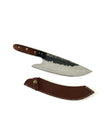
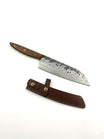
The Fyreza Nakiri is a hand-forged carbon steel vegetable knife with an 18 cm blade length, 7 cm blade height, 32.5 cm overall length, and a weight of approximately 260 g. It features a wide, rectangular blade with visible forge marks, a dark natural wood handle, and includes a faux leather sheath.
The Japanese vegetable knife, hand-forged
In Japanese cuisine, the Nakiri is the knife for vegetables. Its straight edge rests along its entire length on the cutting board, allowing you to cut with a push motion instead of a rocking motion, and every cut goes through cleanly. Herbs, root vegetables, cabbage, onions: paper-thin or coarse, without anything sticking.
The 7 cm high blade provides space for your knuckles and allows you to scoop the cut vegetables directly onto the board. The hammer marks on the forge finish are not decorative; they are proof that this knife was shaped by hand. No two pieces are exactly alike.
Carbon steel with 58 HRC
Carbon steel can be ground to a finer edge than stainless steel and holds its edge longer. You'll immediately notice this with the Nakiri, where thin, precise cuts are crucial. The steel is not stainless: after rinsing, dry it immediately and oil it thinly occasionally. Over time, a dark patina will form, protecting the blade.
Handle and Sheath
The dark natural wood handle is ergonomically shaped, with a black bolster at the transition to the blade and an inlaid brass medallion. The faux leather sheath with brass rivets protects the edge in the drawer and when on the go.
Nakiri, Santoku or Kiritsuke?
| Nakiri | Santoku Pro | Kiritsuke | |
|---|---|---|---|
| Blade Length | 18 cm | 21 cm | 17.5 cm |
| Blade Height | 7 cm | 5.5 cm | 4.5 cm |
| Weight | approx. 260 g | approx. 250 g | approx. 165 g |
| Steel | Carbon Steel | Böhler N690, stainless | C100 Carbon Steel |
| Blade Shape | straight, no tip | slightly curved, rounded tip | straight, Tanto tip |
| Ideal for | Vegetables and herbs with push-cut | All-round, fish, vegetables, easy care | All-round, precise piercing and slicing |
In short: If you cut a lot of vegetables, choose the Nakiri. If you want an all-purpose knife, choose the Santoku or Kiritsuke.
Care
- Hand wash, dry immediately, do not put in the dishwasher
- Occasionally oil the blade thinly, treat the wooden handle with care oil from time to time
- Sharpen on a whetstone, or send it to our sharpening service
For more details, refer to the Care Instructions for Hand-Forged Carbon Steel Knives.
Scope of delivery
Nakiri knife with faux leather sheath. Hand-forged in Bosnia.
Technical Data
| Blade length | 18 cm |
|---|---|
| Overall length | 32.5 cm |
| Blade height | 7 cm |
| Blade thickness at the spine | 2 mm |
| Weight | approx. 260 g |
| Steel | Carbon steel |
| Hardness | 58 HRC |
| Handle | Dark natural wood |
| Scope of delivery | Knife with imitation leather sheath |
| Production | Hand-forged in Bosnia |
Measurements are handcrafted measurements and may vary slightly. Each piece is unique.
Leather strops for resharpening, our sharpening service and the care instructions for carbon steel knives. All models: hand-forged knives.
We deliver within 2-4 business days.
Free shipping in DE&AT for orders over €100.
----------
A return from Germany costs €7.00, regardless of size.
A return from Austria costs between €12.00 and €18.00 (depending on the size of the package). The return shipping costs are charged 1:1 and deducted from the credit note.
We have no influence on these costs.
It is best to use the box we delivered. Please simply stick the return label, which you will receive by email, on the outside of your return. This ensures that the return always goes to the correct address.
What is a Nakiri knife suitable for?
The Nakiri is the quintessential Japanese vegetable knife. With its wide, rectangular blade, it cuts vegetables, herbs, and roots with exceptional precision – cleanly, quickly, effortlessly. The straight edge allows for complete cuts without dragging or rocking. Ideal for julienne, brunoise, thin slices, and precise chopping. Less suitable for meat or fish – but unsurpassed for vegetables.
What is the difference between Nakiri and Santoku?
Both are Japanese kitchen knives, but with different focuses. The Nakiri has a straight, rectangular blade without a tip – specialized in vegetables for push-cutting. The Santoku is more versatile: it has a slightly curved blade with a tip and is suitable for vegetables, fish, and meat. Those who cut only vegetables opt for the Nakiri – those looking for an all-rounder choose the Santoku.
What is the difference between Nakiri and a chef's knife?
A classic chef's knife has a curved blade for rocking cuts and a tip for piercing tasks. The Nakiri has a straight blade without a tip – ideal for push-cutting directly on the board. When cutting vegetables, the Nakiri is more precise and efficient, while the chef's knife has an advantage for meat and fish. Both complement each other perfectly in the kitchen.
Why carbon steel for a Nakiri – and not stainless steel?
Carbon steel can be sharpened more acutely than stainless steel and holds its edge longer. Especially with a Nakiri, where wafer-thin, precise cuts are crucial, this makes a noticeable difference. The only disadvantage: carbon steel is not rust-proof and requires a bit more care. However, it develops a natural patina that protects the blade and gives it character.
How do you sharpen a Nakiri knife correctly?
The Fyreza Nakiri made of carbon steel is best sharpened with a whetstone. Recommended sharpening angle: 10–15° per side – flatter than European knives, for a finer edge. Coarse stone (400–800 grit) for shaping, medium stone (1000–2000) for regular sharpening, fine stone (3000–6000) for refining. Finish by stropping on a leather strop.
How do you care for a hand-forged carbon steel Nakiri?
After each use, wash immediately and dry thoroughly – never in the dishwasher. Occasionally rub with a drop of camellia oil or mineral oil, especially for longer storage. The resulting patina is not a defect – it naturally protects the blade from corrosion. Store in the included faux leather sheath to protect the edge.
What does "Schmiedehaut" (forge scale) mean on a Nakiri?
The "Schmiedehaut" (forge scale) is the characteristic, rough surface that arises during forging and is deliberately preserved. It is a sign of genuine craftsmanship and not a defect. Practically, it has an advantage: food adheres less to the blade, as the rough surface reduces the contact area. Each forge scale is unique – like a blacksmith's fingerprint.
What is included with the Fyreza Nakiri?
The Fyreza Nakiri comes with a high-quality faux leather sheath with brass rivets. The sheath protects the delicate carbon steel blade from moisture and damage and ensures safe storage – whether in a drawer or on the go. Each knife is a handmade unique piece with visible hammer marks as proof of true craftsmanship.