

Fyreza Kiritsuke Knife
Delivery time: 🇦🇹 3-4 | 🇩🇪 2-3 working days
- 10-year guarantee
- Free shipping from €100
- 30-day returns
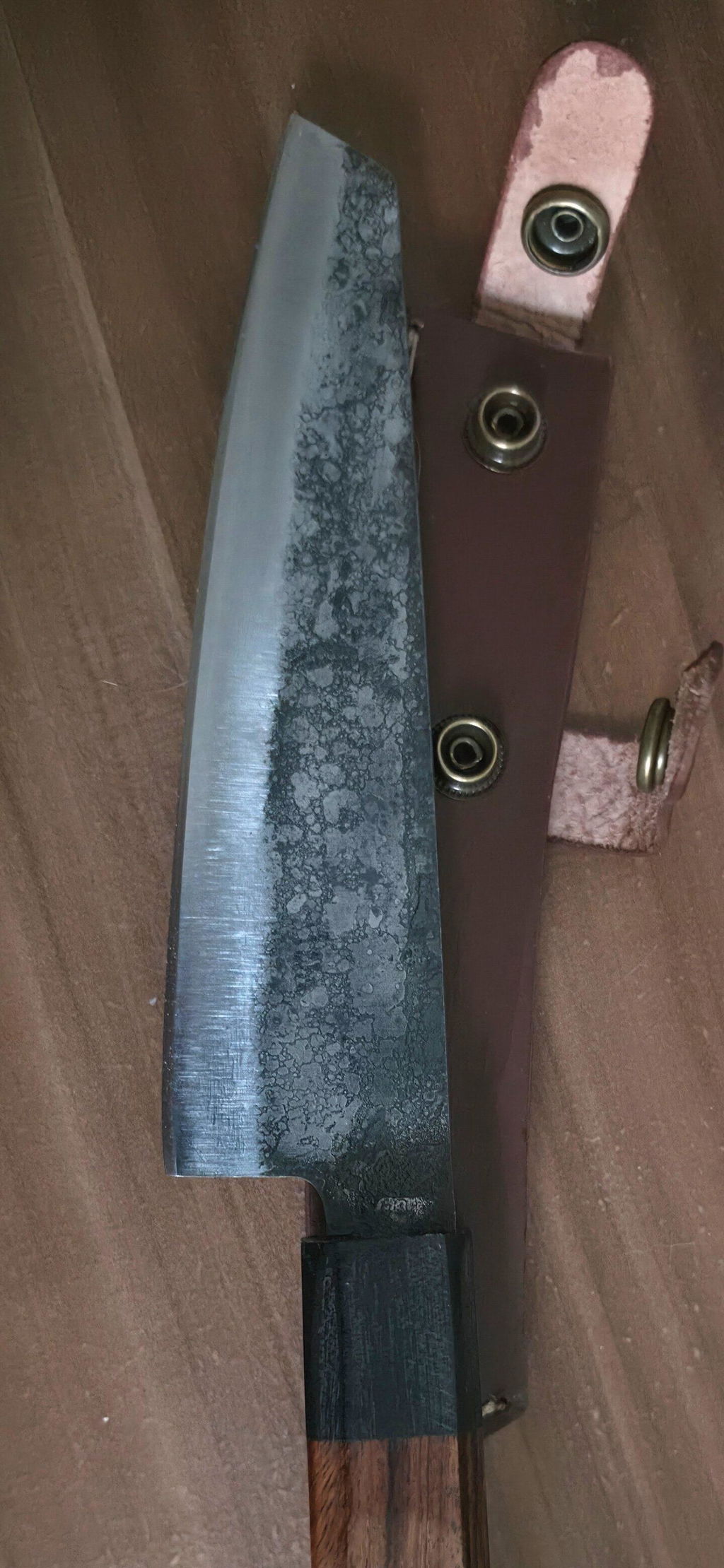
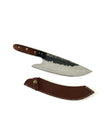
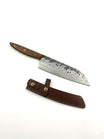
The Fyreza Kiritsuke is a hand-forged kitchen knife made from C100 carbon steel with a 17.5 cm blade length, 4.5 cm blade height, 31 cm overall length, and weighing only around 165 g. Straight blade with tanto tip, natural wood handle, imitation leather sheath included.
The Chef's Knife, Now in Your Kitchen
The Kiritsuke was traditionally reserved for the head chef in Japan. Two features distinguish it: the angled tanto tip for precise piercing and incising, and the flat blade profile for the push-cut, meaning slicing by pushing rather than rocking. This makes it the most versatile knife in Japanese cuisine: for vegetables, fish, meat, herbs.
At 165 g, it is significantly lighter than a European chef's knife. You guide it from the wrist, not the arm, and won't tire even after an hour at the cutting board.
C100 Carbon Steel, No Recycled Material
The blade is forged from C100, a virgin steel with around 1.0% carbon. No old leaf springs, no scrap: controlled steel with consistent hardness of 58 HRC. It takes a finer edge than stainless steel, can be resharpened in minutes, and develops a dark patina over time that protects it.
Handle and Sheath
The natural wood handle fits ergonomically in the hand, with each grain unique. The imitation leather sheath protects the blade from moisture and makes the knife safely transportable.
Kiritsuke, Chef Evolution or Mini Kiritsuke?
| Kiritsuke | Chef Evolution | Mini Kiritsuke | |
|---|---|---|---|
| Blade Length | 17.5 cm | 25 cm | 12.5 cm |
| Overall Length | 31 cm | 34 cm | 26 cm |
| Weight | approx. 165 g | approx. 300 g | approx. 100 g |
| Steel | C100 Carbon Steel | C125S Carbon Steel | Carbon Steel |
| Ideal for | light all-round knife, push-cut | large cuts of meat, rocking motion, open fire cooking | peeling, small cutting tasks, outdoor |
In short: The Kiritsuke is the middle ground. If you want something heavy and long, choose the Chef Evolution. If you're looking for a small secondary knife, the Mini Kiritsuke.
Care
- Wash immediately after use and wipe dry, do not put in the dishwasher
- Occasionally rub with a drop of camellia or mineral oil
- Resharpen on a whetstone or via our sharpening service
Further details can be found in the Care Instructions for Carbon Steel Knives.
Scope of Delivery
Kiritsuke knife with imitation leather sheath. Hand-forged in Bosnia.
Technical Data
| Blade length | 17.5 cm |
|---|---|
| Overall length | 31 cm |
| Blade height | 1.77 in |
| Spine thickness | 2.5 mm |
| Weight | approx. 165 g |
| Steel | C100 Carbon Steel |
| Hardness | 58 HRC |
| Handle | Natural wood |
| Scope of delivery | Knife with imitation leather sheath |
| Production | Hand-forged in Bosnia |
Measurements are handcrafted measurements and may vary slightly. Each piece is unique.
Leather strops for resharpening, our sharpening service and the care instructions for carbon steel knives. All models: hand-forged knives.
We deliver within 2-4 business days.
Free shipping in DE&AT for orders over €100.
----------
A return from Germany costs €7.00, regardless of size.
A return from Austria costs between €12.00 and €18.00 (depending on the size of the package). The return shipping costs are charged 1:1 and deducted from the credit note.
We have no influence on these costs.
It is best to use the box we delivered. Please simply stick the return label, which you will receive by email, on the outside of your return. This ensures that the return always goes to the correct address.
What is a Kiritsuke knife and what is it used for?
The Kiritsuke is a Japanese multi-purpose knife with two characteristic features: the angled Tanto tip and the flat blade profile. Traditionally, it was reserved only for the head chef – a symbol of mastery. Today, it is suitable for precise vegetable cutting, filleting fish, and portioning meat. The flat profile makes it ideal for the Japanese push-cut – slicing instead of rocking.
What is the difference between Kiritsuke and Gyuto?
The Gyuto is the Japanese equivalent of the Western chef's knife – with a curved blade and tip, ideal for rocking cuts. The Kiritsuke has a straight blade with an angled Tanto tip – ideal for push-cuts and precise piercing. The Kiritsuke is considered more demanding to handle, but in skilled hands, it delivers superior cutting precision.
What is the difference between Kiritsuke and Santoku?
The Santoku is shorter, lighter, and more beginner-friendly – an all-rounder for everyday use. The Kiritsuke is longer, has a characteristic Tanto tip, and a flatter blade profile – it is more precise but also more demanding to handle. Those who master Japanese cutting techniques and seek maximum precision opt for the Kiritsuke.
What is C100 Carbon Steel – and why virgin steel?
C100 is a high-quality carbon steel with ~1.0% carbon content – made from pure virgin steel, no recycled material, no leaf springs. This guarantees uniform hardness and defined material properties. C100 can be sharpened more acutely than stainless steel, holds its edge longer, and develops a natural patina over time. A steel for chefs who make no compromises.
How do you properly sharpen a Kiritsuke knife?
The Kiritsuke made of C100 Carbon Steel is best sharpened with a whetstone. Recommended sharpening angle: 10–15° per side – flatter than European knives. Coarse stone (400–800 grit) for establishing the edge, medium stone (1000–2000) for regular touch-ups, fine stone (3000–6000) for refining. Finally, polish on a leather strop. C100 takes sharpness quickly.
How do you care for a Kiritsuke made of C100 Carbon Steel?
After each use, wash immediately and wipe dry – never in the dishwasher. Occasionally rub with a drop of camellia oil or mineral oil. Allow the faux leather sheath to dry after use before inserting the knife. The resulting patina is not a defect – it naturally protects the blade from corrosion and gives it character.
What does Tanto tip mean on a Kiritsuke?
The Tanto tip is the most characteristic feature of the Kiritsuke: The blade does not curve to a point but has an angled, straight end – like a Japanese Tanto sword. This allows for precise piercing and cutting in hard-to-reach areas. In combination with the flat blade profile, the Tanto tip makes the Kiritsuke one of the most precise kitchen knives available.
Why does the Kiritsuke weigh only 165 g?
The low weight of 165 g is no coincidence – it is the result of the slim blade geometry (17.5 cm length, 4.5 cm height, 2.5 mm thickness) and the light natural wood handle. A light knife fatigues the hand less during longer work and allows for more precise, controlled cuts. Especially for the Japanese push-cut, a light knife is advantageous.