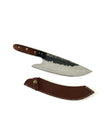
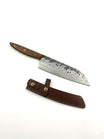

In short: The chef's knife is longer, more pointed and built for the rocking cut: the all-rounder for large quantities, meat and firm vegetables. The santoku is shorter, wider and lighter, with a flat edge for precise pull and push cuts. If you cut a lot of vegetables and like a handy knife, take the santoku. If you are looking for one knife for everything, take the chef's knife.
What is the difference between a santoku and a chef's knife?
The European chef's knife has a long blade that curves towards the tip, usually 20 to 26 cm. The curve allows the rocking cut: the tip stays on the board while the blade rocks through herbs and onions. The tip is used to trim meat, the length to split a cabbage.
The Japanese santoku (the name means "three virtues": meat, fish, vegetables) is shorter, usually 16 to 21 cm, with a wider blade, a flatter edge and a rounded tip. It cuts with a pulling stroke or by pushing forward, not by rocking. The wide blade keeps your knuckles off the board and works as a scoop to lift what you have cut into the pan.
| Chef's knife | Santoku | |
|---|---|---|
| Blade length | 20 to 26 cm | 16 to 21 cm |
| Edge | curved, pointed tip | flat, rounded tip |
| Cutting technique | rocking cut, pull cut | pull and push cut |
| Strengths | large quantities, meat, firm vegetables | vegetables, fish, fine slices |
| Feel | longer, more powerful | compact, light, nimble |
Which knife suits you?
Take the chef's knife if you often cook for many people, cut whole cabbages, pumpkins or large pieces of meat and are used to the rocking cut. Our Chef Evolution has a 25 cm blade, a blade height of 7 cm and weighs around 300 g, hand-forged from C125S carbon steel with 58 HRC.
Take the santoku if you mainly cut vegetables, fish and portion-sized meat, prefer a lighter knife or have smaller hands. We make three:
| Santoku Pro | Santoku Pro Forged | Santoku kitchen knife | |
|---|---|---|---|
| Blade length | 21 cm | 21 cm | 16.5 cm |
| Blade height | 5.5 cm | 5.5 cm | 5 cm |
| Weight | approx. 250 g | approx. 250 g | approx. 160 g |
| Steel | Böhler N690, stainless | C100 carbon steel | 1.4116, stainless |
| For whom | low maintenance, no patina | finest edge, with patina | light and compact for every day |
Nakiri or santoku?
The nakiri is the pure vegetable knife of Japanese cuisine: a rectangular blade, a completely straight edge and no tip. The straight edge touches the board along its whole length, so nothing stays connected when chopping: herbs, cabbage and onions come out paper-thin. It is not built for meat on the bone or for trimming.
If you cut almost only vegetables, the nakiri (18 cm blade, 7 cm high, approx. 260 g) is the fastest. If you also cut meat and fish, take the santoku.
Stainless or carbon steel?
Carbon steel gets harder, takes a finer edge and can be resharpened in minutes. In return, it wants to be dried and lightly oiled after washing and develops a grey patina over time. Stainless steel such as Böhler N690 is more forgiving and needs hardly any care. How to care for carbon steel is explained in our guide caring for carbon steel knives.
Frequently asked questions
Can a santoku replace a chef's knife?
For most everyday kitchen work, yes. It reaches its limits with very large items and with the rocking cut, which its flat edge is not made for.
Which blade length makes sense for a santoku?
16 to 18 cm is handy and light, 20 to 21 cm also manages larger pieces. If you only buy one knife, the longer blade is the better choice.
What does santoku mean?
"Three virtues". It refers to the three things the knife cuts: meat, fish and vegetables.
Is a santoku suitable for beginners?
Yes. The shorter, wide blade is easy to control, and the straight pull cut is quickly learned.
You will find all blades from our forge in the knife collection.